Top 10 Economic Risks Facing Australia in 2027
Australia enters 2027 with inflation still the central near-term risk, but the larger challenge is a combination of high household debt, weak productivity, housing constraints and an uncertain global economy. None of these guarantees a recession. The danger is that several arrive together and leave policymakers with conflicting choices.
The Reserve Bank of Australia held the cash rate at 4.35 per cent in August 2026 after three increases during the year, and its forecasts did not return underlying inflation to the midpoint of the target until around early 2028. That makes the starting position more restrictive than many households expected.
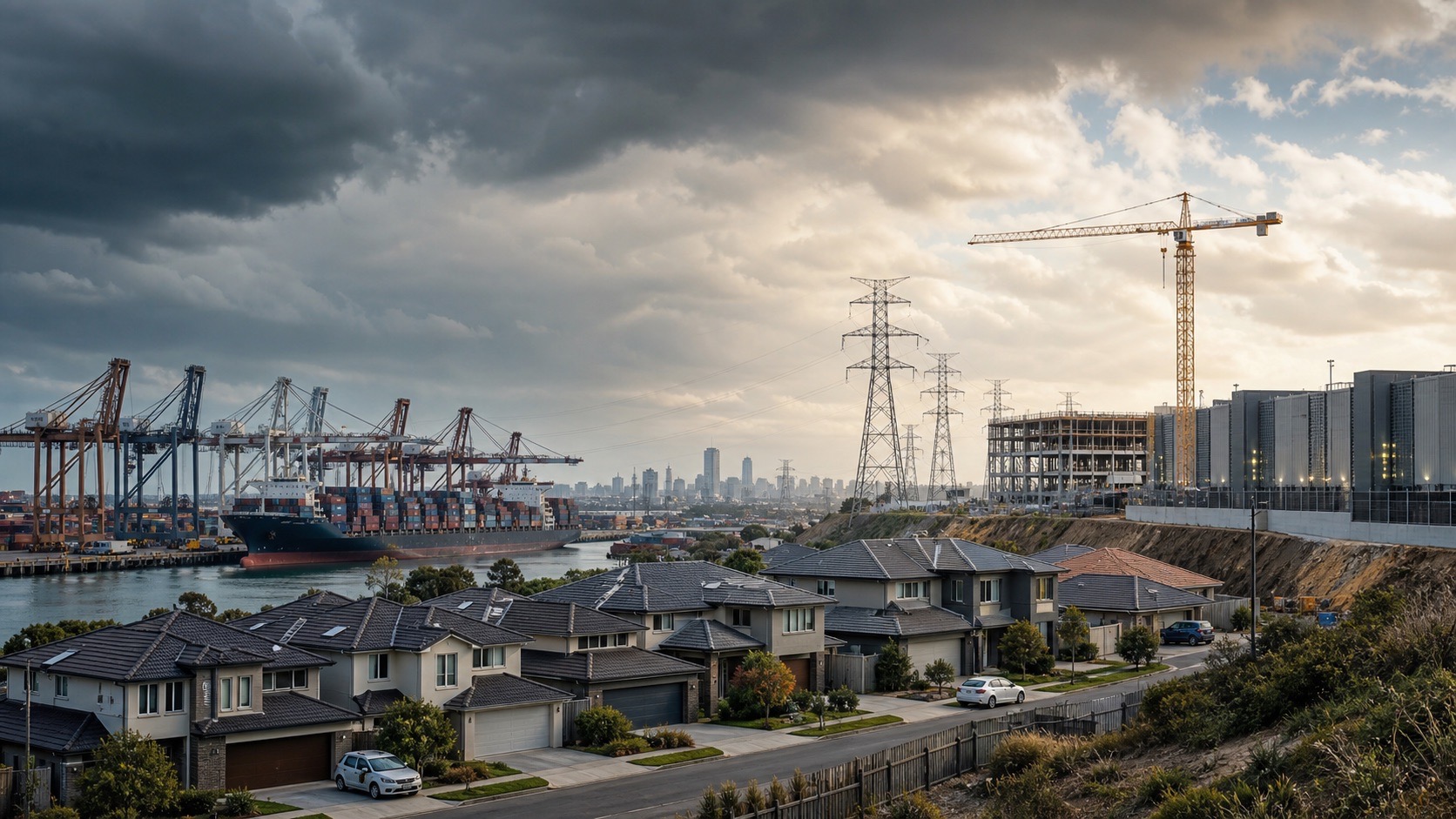
Australia's 2027 risk map
| Risk | Transmission to households | Signal to watch |
|---|---|---|
| Persistent inflation | Higher essentials and interest rates | Trimmed-mean inflation and services prices |
| Household debt stress | Reduced spending and arrears | Mortgage delinquencies and consumption |
| Weak productivity | Slower real wage and income growth | Output per hour and business investment |
| Housing shortage or correction | Rent pressure or wealth shock | Approvals, completions, rents and prices |
| China and trade disruption | Export, currency and job effects | Commodity demand and trade restrictions |
| Labour and skills mismatch | Wage pressure alongside unemployment | Vacancies, participation and underemployment |
| AI and data-centre imbalance | Investment concentration and power demand | Capacity, productivity and project delivery |
| Energy-transition bottlenecks | Higher bills and unreliable investment | Grid projects, closures and wholesale prices |
| Climate and insurance costs | Uninsured homes and public losses | Premiums, coverage withdrawal and disasters |
| Fiscal and cyber shocks | Reduced policy room and service disruption | Debt costs and critical-infrastructure incidents |
These risks interact. A global energy shock can lift inflation, delay rate cuts, weaken household spending and increase government support costs at once.
1. Inflation stays above target for longer
The RBA's August 2026 assessment described inflation as above target and demand as stronger than the economy's productive capacity. Services, housing and energy pressures can persist even when some goods prices ease. Geopolitical conflict adds another route through oil and shipping.
If inflation remains sticky, the Bank may keep rates high or tighten further. That reduces borrowing and spending but cannot quickly build homes, power lines or skilled-workforce capacity. The cure can therefore weaken growth before supply improves.
Watch quarterly trimmed-mean inflation, market-services prices, rents and inflation expectations rather than one volatile monthly headline. A slow decline would not mean policy failed, but it would keep mortgage and business planning difficult.
2. Household debt turns restraint into stress
Australian households carry high debt relative to income, much of it tied to variable-rate or relatively short fixed-rate mortgages. Rate increases pass through more quickly than in the long-fixed US mortgage market. Borrowers who expected easing face a larger repayment burden.
Most households may continue paying by cutting discretionary spending. That protects bank loan books but hurts retailers, hospitality and small businesses. A rise in unemployment would be more dangerous because income, not only cash flow, disappears.
Monitor arrears, hardship applications, forced listings and real consumption per person. Aggregate savings can hide severe distribution: outright homeowners and indebted younger families experience the same cash rate very differently.
3. Productivity remains weak
Productivity—output per hour worked—is the foundation for sustainable real wage and living-standard growth. Australia's performance has been weak, and the RBA has highlighted capacity and productivity constraints in its inflation outlook.
Poor productivity can turn reasonable wage gains into business cost pressure rather than higher real incomes. Causes include weak capital investment, management quality, infrastructure, competition, skills matching and the difficulty of measuring service-sector output.
AI could help, but purchasing software is not productivity. Firms must redesign processes, train people and protect data. Watch non-mining business investment, capital per worker, diffusion of technology and whether measured productivity improves beyond a rebound from unusual pandemic-era patterns.
4. Housing shortage and correction risks coexist
Australia needs more well-located housing, yet high construction costs, builder failures, planning delays, infrastructure constraints and expensive finance limit supply. Rents can remain high even if established home prices weaken.
At the same time, stretched prices and mortgage burdens create correction risk. A sharp fall would reduce household wealth, damage confidence and leave some recent buyers with little equity. A renewed surge would worsen affordability and labour mobility.
Completions, not announcements, are the critical signal. Track approvals, construction times, insolvencies, vacancy rates and rents. Policy must distinguish social and affordable supply from measures that increase buyers' borrowing capacity without adding homes.
5. China slowdown or trade conflict hits exports
China remains a central market for Australian resources and services. A property slowdown, weak industrial demand or broader financial stress can lower commodity volumes or prices, affecting company profits, the Australian dollar, government revenue and mining-region employment.
Trade restrictions or geopolitical tension can affect agriculture, education and tourism as well as minerals. Diversification into India, Southeast Asia and other markets helps but cannot instantly replace the scale of Chinese demand.
Watch iron ore and liquefied natural gas volumes and prices, Chinese construction indicators, student flows and trade measures. A lower dollar can cushion exporters while raising imported inflation, creating another policy conflict.
6. Labour shortages and unemployment rise together
An economy can have persistent shortages in health, construction and technical roles while unemployment rises elsewhere. Skills, location and working conditions prevent an instant match. Ageing increases care demand and retirements, while migration changes both labour supply and demand for housing and services.
If the economy slows, entry-level and discretionary-service jobs may weaken first. Long vacancies in essential sectors can continue. This mismatch restrains projects and creates wage pressure without delivering broad worker security.
Monitor underemployment, hours, participation, vacancies by occupation and wage growth rather than only the unemployment rate. Training pipelines and recognition of skills take years, making sudden policy changes disruptive.
7. AI and data-centre investment becomes unbalanced
AI infrastructure can lift business investment and eventually productivity. Data centres also require large amounts of power, network capacity, water in some designs and specialised equipment. A rush of projects may compete with households and industry for constrained infrastructure.
The financial risk is concentration. If expected AI demand or revenue disappoints, delayed projects could expose developers, lenders and suppliers. If it accelerates, grid and planning bottlenecks may raise costs.
Watch firm connection agreements, generation and transmission delivery, computing imports and evidence of productivity outside the technology sector. Australia benefits most if infrastructure enables broad adoption rather than becoming an isolated construction boom.
8. Energy transition timing raises costs
Ageing coal generation is retiring while renewable generation, transmission, storage and firming must arrive in sequence. Delays can increase wholesale volatility or require expensive life extensions. Poorly coordinated investment risks both reliability and affordability.
Global fuel shocks still matter because gas and oil influence transport, industry and electricity. Household electrification can reduce exposure over time, but upfront costs and rental housing constraints make benefits uneven.
Track transmission milestones, firm capacity, outage rates, contract prices and project cancellations. Political certainty matters because energy assets last decades. Cost estimates should include networks and reliability, not only generation.
9. Climate disasters make homes harder to insure
Flood, bushfire, cyclone and heat risk increasingly appear in insurance premiums, exclusions and property values. A home can be physically intact yet financially impaired if affordable cover disappears. Local governments and infrastructure providers face repeated repair bills.
Underinsurance shifts losses to households and government after disasters. It also affects mortgages because lenders require cover. Retreat, resilience construction and land-use decisions involve difficult distributional choices.
Monitor premium-to-income ratios, policy non-renewals and repeated-loss areas. Adaptation investment can reduce damage, but it must be targeted using transparent risk data and accompanied by building and planning reform.
10. Fiscal pressure and critical-infrastructure cyber risk
Higher interest costs, ageing-related health and care spending, defence commitments and disaster recovery narrow budget flexibility. Commodity-revenue windfalls can mask structural deficits. A downturn would reduce revenue just as support needs rise.
Cyber incidents add a less predictable fiscal and economic shock. Disruption to payments, telecommunications, ports, hospitals or energy could halt activity even without physical damage. Concentrated service providers create systemic dependencies.
Watch net interest, spending quality, tax-base resilience and implementation of critical-infrastructure security obligations. Governments need buffers for genuine shocks while ensuring permanent commitments have durable funding.
What could go better than expected?
Risk analysis should not be a recession forecast. Faster productivity gains, successful disinflation, stronger business investment and well-sequenced housing and energy construction could lift supply and real incomes. A soft landing would let rates eventually normalise without a large employment loss.
China could stabilise, commodity demand from the energy transition could remain strong and migration could improve skill matching. AI may spread beyond large firms more effectively than cautious forecasts assume.
The upside case still requires execution. Announced projects and technologies matter only when they raise delivered capacity and output.
What households and businesses can do
Households can stress-test repayments, maintain accessible savings, avoid relying on one rate forecast and review insurance for realistic rebuilding costs. Career and location decisions should account for industry concentration and climate exposure.
Businesses can model energy, currency and borrowing shocks; diversify critical suppliers; secure backups and access controls; and stage investment around measurable demand. Hedging and financial products require advice and should not be improvised.
This article is general economic analysis, not personal financial advice. Forecasts are uncertain and policy, markets and individual circumstances change.
Australia's central 2027 challenge
Australia's greatest risk is not one dramatic event. It is a supply-constrained economy meeting repeated demand and global shocks while indebted households absorb high rates. Productivity, housing and energy delivery are the durable solutions; monetary policy can only manage the pressure.
Follow Sarvalaya's Australian economics coverage for updates as inflation, growth and investment data clarify the 2027 outlook.