Top 10 Careers Least Likely to Be Replaced by AI
No career is immune to artificial intelligence. The safer question is which jobs combine tasks that are difficult to automate with growing demand, trusted human relationships, physical environments and legal accountability. In many such careers, AI will change the work before it removes the occupation.
Nursing, electrical trades, therapy, teaching and skilled maintenance are strong examples. Australian labour-market research expects generative AI to augment more jobs than it automates, while US projections show rapid growth in several healthcare roles. The most resilient worker will learn to supervise useful tools without surrendering judgement.
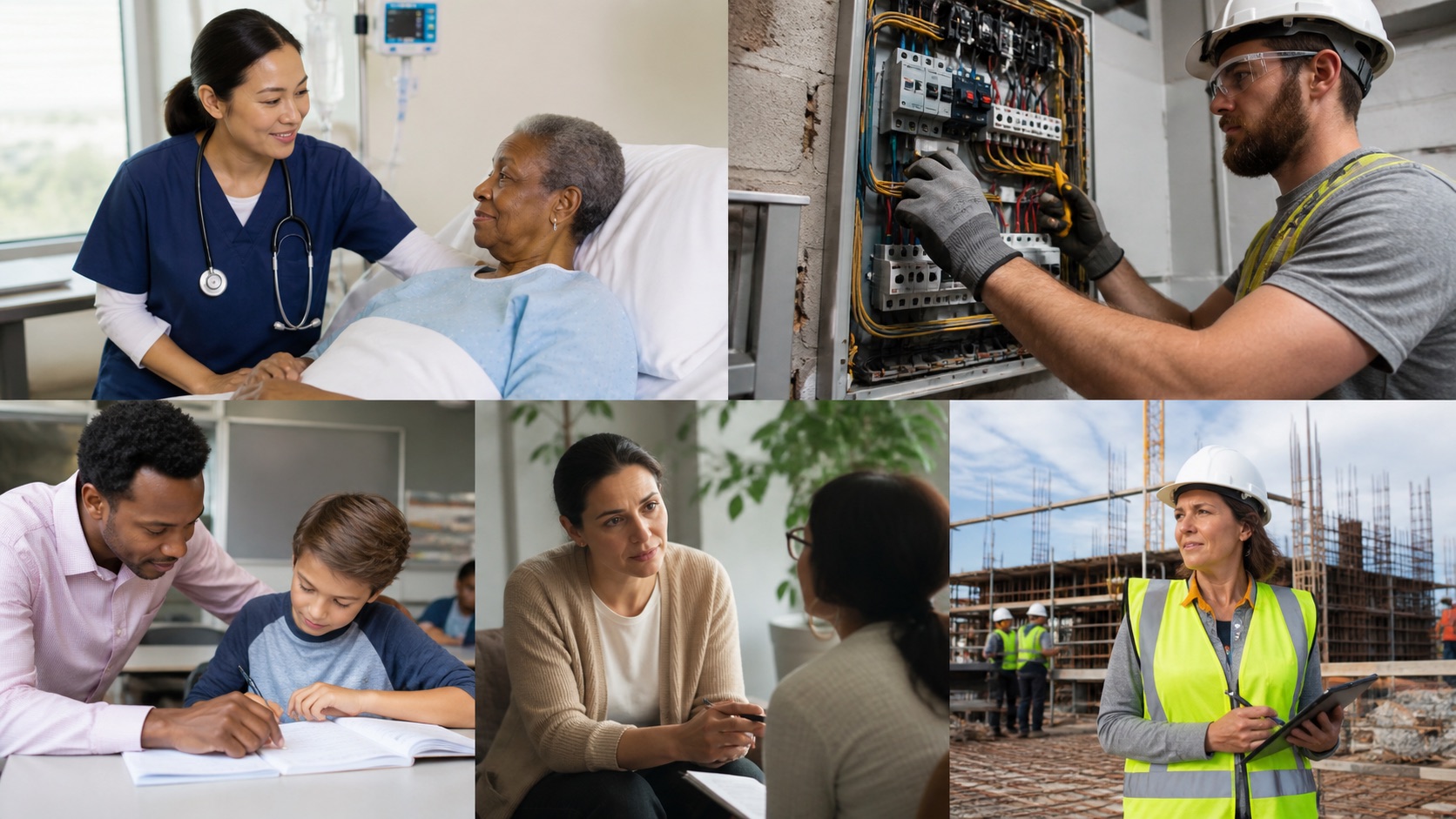
AI-resilient careers at a glance
| Career field | Why it resists full automation | How AI will change it |
|---|---|---|
| Nurses and advanced practitioners | Physical care, trust and accountability | Documentation and clinical support |
| Electricians and energy technicians | Unstructured sites and licensed safety work | Diagnostics and job planning |
| Plumbers and HVAC technicians | Physical troubleshooting in varied buildings | Predictive maintenance and quoting |
| Therapists and counsellors | Relationship, context and ethical responsibility | Notes and supervised support tools |
| Teachers and trainers | Motivation, safeguarding and adaptation | Lesson preparation and feedback drafts |
| Social workers and care coordinators | Complex human systems and field work | Case administration and resource search |
| Emergency services | High-stakes action in changing environments | Dispatch, sensing and decision aids |
| Medical technologists and sonographers | Patient handling plus specialist interpretation | Image support and workflow automation |
| Cybersecurity incident responders | Adversarial judgement and accountability | Faster detection and investigation |
| Construction supervisors | On-site coordination, safety and negotiation | Scheduling, monitoring and documentation |
“Resistant” does not mean unchanged or guaranteed. Location, credentials, health, wages and economic cycles should influence a career decision.
1. Nurses and advanced health practitioners
Nursing combines observation, physical procedures, communication, prioritisation and accountability in unpredictable settings. A model can summarise a chart, but it cannot independently reposition a frail patient, notice a subtle change while providing care and accept professional responsibility.
Demand is supported by ageing populations and chronic illness. US projections published for 2025–35 show strong growth across healthcare, with nurse practitioner employment among the fastest-growing occupations. Australia also faces continuing care and health-workforce needs.
AI will reduce some documentation and support triage, monitoring and education. Nurses who understand data quality, escalation and tool limits will be more valuable. Entry requires accredited education, registration and emotionally demanding work; resilience should not be confused with easy conditions.
2. Electricians and renewable-energy technicians
Electrical work occurs in old homes, construction sites, factories, solar arrays and energy systems that rarely match a perfect digital model. Licensed workers must diagnose physical faults, isolate hazards, comply with codes and certify work.
Electrification creates additional demand through solar, batteries, vehicle charging, heat pumps, grids and data centres. US projections identify solar photovoltaic installers among fast-growing occupations, while Australia's energy transition needs qualified trades.
AI will assist quoting, load calculations, diagrams and fault diagnosis. It will not remove the need for site verification and safe physical execution. Apprenticeship and licensing take time, and work can be physically risky, but the combination of scarcity, regulation and field skill is durable.
3. Plumbers, HVAC and building-service technicians
Buildings contain concealed pipes, improvised renovations, corroded parts and occupants who cannot wait for a robot-ready environment. Plumbers and heating, ventilation and air-conditioning technicians combine diagnosis, dexterity, customer judgement and regulated safety.
Climate adaptation and building electrification increase the need for efficient cooling, heat pumps, water systems and retrofits. Emergency work also resists centralisation because a person must reach the site.
AI can interpret sensor data, predict failures and prepare parts lists. Technicians should learn connected controls and energy efficiency alongside traditional skills. Physical strain, licensing and after-hours work are real drawbacks and should be evaluated honestly.
4. Therapists, counsellors and psychologists
Effective therapy depends on trust, ethics, context and a professional's ability to respond to ambiguity or risk. Conversational systems can provide general exercises or journalling prompts, but they cannot assume the complete duty of care for crisis, diagnosis and treatment.
Demand for mental-health services remains substantial. The constraint is often affordable access and workforce supply rather than absence of need. Human practitioners who serve children, families, trauma or complex conditions are particularly difficult to substitute.
AI may assist notes, scheduling, outcome measures and between-session material under appropriate privacy controls. Practitioners need to assess digital tools rather than recommending them casually. Qualification pathways are long, emotional load is significant and rules differ by jurisdiction.
5. Teachers and skilled trainers
Teaching is more than transmitting information. Educators motivate, diagnose misunderstanding, manage groups, protect children, adapt activities and build a learning culture. Families and institutions expect a responsible human to make consequential decisions.
AI can generate exercises, translate material and offer practice feedback. It can also produce incorrect explanations, enable shortcuts and deepen inequity when access or digital literacy differs. Teachers who design assessment and teach verification become more important.
Subject knowledge alone is insufficient; classroom management and relationship skills create resilience. Vocational trainers combining industry expertise with instruction are also well placed as workers reskill. Workload and pay vary widely and must be researched locally.
6. Social workers and care coordinators
Social work sits inside complicated family, housing, health, justice and benefits systems. Practitioners assess risk, build trust, visit homes, coordinate organisations and make decisions with ethical and legal consequences.
AI may search services, draft routine records and identify missing information, reducing administrative burden. It may also reproduce bias or expose highly sensitive case data. Human review and consent are central.
Population ageing, disability support and social pressures sustain demand, but caseloads and burnout are serious. Resilience comes from irreducible human coordination and accountability, not from a comfortable work environment.
7. Emergency responders
Paramedics, firefighters and other responders work in rapidly changing physical situations with incomplete information. They must communicate under stress, improvise safely and take responsibility for people who may be injured, frightened or unable to cooperate.
Drones, computer vision, decision support and improved dispatch will extend responders' reach. Automated systems can map a fire or suggest a route; trained people still interpret conditions, perform rescue and manage the scene.
These careers demand fitness, training and tolerance for trauma and shift work. Technology competence will become part of professional practice, but high-stakes public legitimacy makes full replacement unlikely.
8. Medical technologists, sonographers and hands-on diagnostics
Diagnostic imaging and laboratory careers are often described as AI targets because pattern recognition is important. In practice, many roles also involve patient positioning, specimen quality, equipment operation, protocol selection, safety and communication with clinicians.
AI can flag images, automate measurements and prioritise cases. That changes task mix and may allow one professional to handle more work. It also creates oversight needs when a model encounters unusual anatomy or poor-quality input.
Workers should pursue recognised credentials and learn quality assurance, informatics and patient care. Roles limited to one repetitive digital classification task face more pressure than positions combining acquisition, interpretation support and direct responsibility.
9. Cybersecurity incident responders
Cybersecurity is an adversarial field: attackers change tactics in response to defences. Incident responders decide whether an alert is real, contain systems, preserve evidence, communicate with leaders and restore operations under pressure.
AI already improves log analysis, malware triage and query generation. Attackers use it too. Organisations still need accountable people to understand business context, authorise disruption and manage legal or customer consequences.
Entry is not secured by collecting generic certificates. Build networking, operating-system, cloud and scripting foundations; practise in labs; and learn concise incident communication. Some routine security monitoring will automate, while investigation and architecture skills become more valuable.
10. Construction and infrastructure supervisors
Supervisors coordinate trades, materials, weather, design changes, safety and client expectations on a physical site. Each day combines planning with negotiation and immediate problem-solving. Responsibility cannot be reduced to a schedule generated in an office.
AI and computer vision can monitor progress, compare drawings, predict delays and draft reports. Building information models improve coordination. Supervisors who use these tools can manage complexity more effectively.
The durable skills are sequencing, safety leadership, reading plans, commercial judgement and trust across trades. Construction remains cyclical, so workers should develop transferable project and compliance skills rather than assuming permanent local demand.
What makes a career more resilient?
Four characteristics recur. First, the work changes the physical world in varied settings. Second, the customer needs empathy, persuasion or trust. Third, a licensed person or organisation must accept responsibility. Fourth, demand grows because of demographics, infrastructure or security rather than a temporary trend.
Careers mixing these features with digital tools are stronger than careers composed solely of routine screen tasks. However, a job title contains many tasks. AI can remove entry-level drafting from a resilient profession, altering the path by which beginners learn.
Examine the actual local labour market: vacancy duration, pay progression, qualification cost, physical demands and geographic mobility. A theoretically safe occupation is a poor choice if it conflicts with health, aptitude or available training.
Build an AI-resilient skill portfolio
Develop one domain skill employers can verify, one human skill colleagues trust and one technical skill that improves leverage. An electrician might add battery commissioning and customer explanation. A nurse might add informatics and clinical education. A teacher might add assessment design and accessibility.
Use AI to accelerate low-risk tasks while keeping the ability to work when it fails. Learn to verify outputs, protect confidential information and explain decisions. Keep examples of completed work and measured outcomes rather than listing “AI” as a vague capability.
Career decisions involve uncertainty, and this article is general information rather than personalised education or employment advice. Verify licensing, training costs and labour-market data for your region.
The safest career strategy is adaptation
Nursing, trades, therapy, teaching and emergency response are difficult to automate completely because they join knowledge with people, places and accountability. They will still change. Some administrative tasks will disappear, performance expectations may rise and new specialties will emerge.
Choose meaningful work with durable demand, then become the person who understands both the domain and the tools. Sarvalaya's economics coverage follows how technology is reshaping jobs and households.