Top 10 Home Battery Systems Compared for 2026
The best home battery is the one correctly sized for a household's evening demand, solar output and backup priorities. Capacity alone is not enough. Power output determines which appliances can run together, inverter design affects compatibility, and backup may require extra hardware and switchboard work.
Tesla Powerwall 3 is the strongest all-round package for many Australian homes, while BYD Battery-Box suits modular systems and Sigenergy SigenStor provides an integrated, expandable platform. Sungrow, Enphase and SolarEdge are compelling within matching inverter ecosystems. No ranking replaces a site design by an accredited professional.
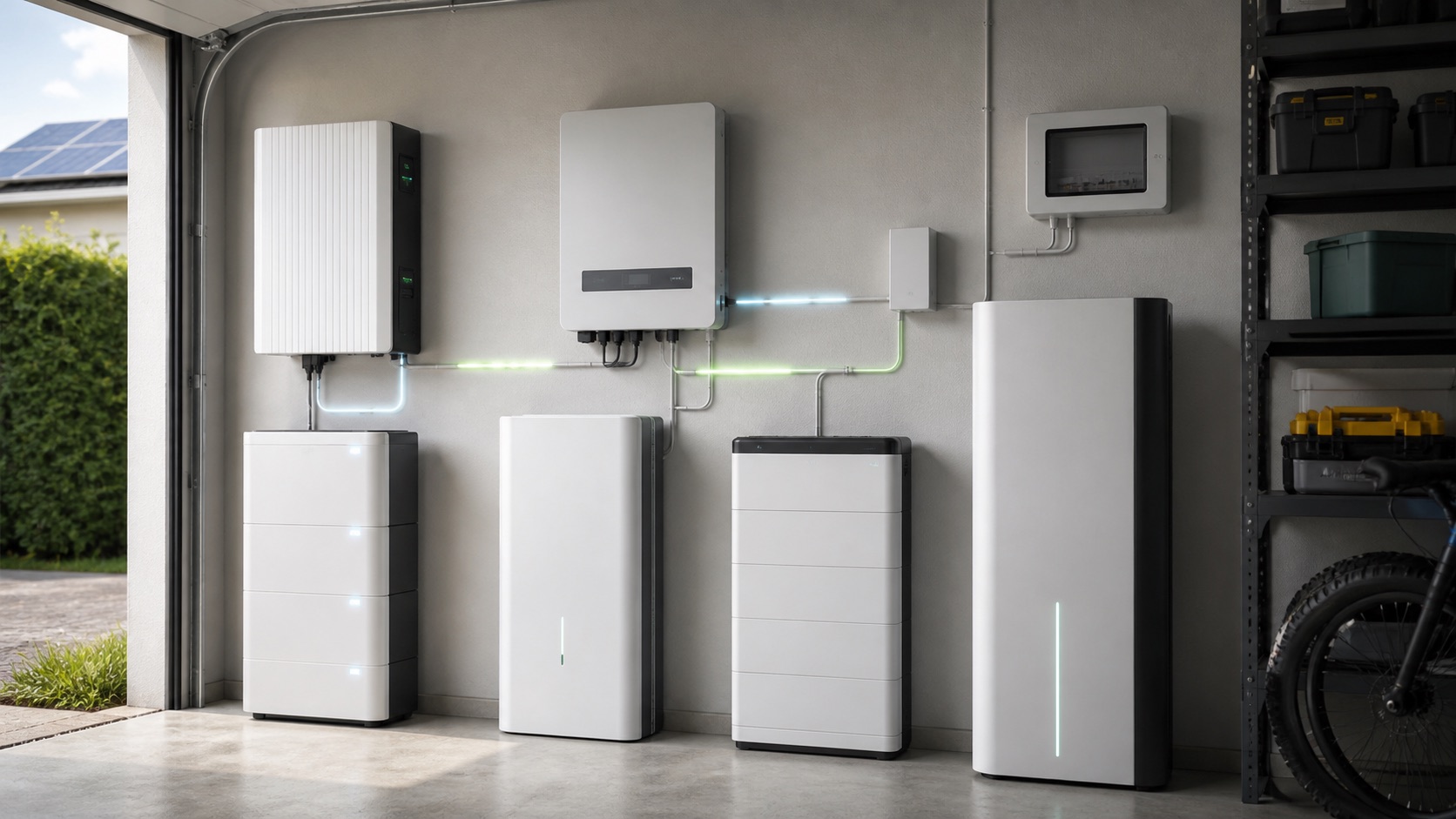
Home battery systems at a glance
| System | Best for | Main consideration |
|---|---|---|
| Tesla Powerwall 3 | Integrated all-round retrofit | Ecosystem and backup design |
| BYD Battery-Box Premium | Modular capacity | Requires a compatible inverter |
| Sigenergy SigenStor | Highly integrated expandable system | Newer ecosystem and installer expertise |
| Sungrow SBR/SBH | Value with Sungrow hybrid inverters | Compatibility by model and phase |
| Enphase IQ Battery 5P | Modular AC-coupled resilience | Higher system cost in some designs |
| SolarEdge Home Battery | SolarEdge households | Best value inside one ecosystem |
| sonnenBatterie Evo | Premium managed energy | Price and installer availability |
| AlphaESS | Broad all-in-one choices | Product and support pathway vary |
| LG Energy Solution Prime | High-voltage retrofit options | Verify recall history and exact model |
| Pylontech | Flexible value storage | Complete-system support rests heavily on installer |
Model availability, approvals and rebates change. The Australian Government's Cheaper Home Batteries Program was adjusted from 1 May 2026 after rapid uptake. Eligibility and discount values must be checked for the installation date.
1. Tesla Powerwall 3: best all-round package
Powerwall 3 combines battery storage with an integrated solar inverter in a compact system. Its roughly 13.5 kWh usable capacity fits many households trying to shift daytime solar into the evening, and its high power capability can support substantial loads when the switchboard and backup design permit.
Tesla's app is approachable, and the product has a large Australian installed base. It can be used in new solar systems or certain retrofits, but the optimal design depends on the existing inverter and array. Full-home backup is not automatic; gateway hardware, phase configuration and protected circuits matter.
The ecosystem is relatively closed, and additional capacity comes in large increments. Ask what continues during a grid outage, whether solar can recharge the battery while islanded and how three-phase loads are treated. Powerwall is the default shortlist choice, not a reason to skip engineering.
2. BYD Battery-Box Premium: best modular battery
BYD's Battery-Box products use stackable modules that can be configured for compatible low- or high-voltage inverter systems. This modularity lets an installer match capacity more closely to the household and expand within approved limits.
BYD supplies the battery rather than one universal inverter and control package. Performance, backup and monitoring therefore depend on the paired inverter and system design. That flexibility is useful for customers who prefer brands such as Fronius or SMA where supported.
Confirm the exact HVS, HVM or other product family, module count, inverter firmware and approval. Expansion can require modules of compatible age and state, so “add more later” needs a written plan. BYD is strongest for technically well-designed modular systems.
3. Sigenergy SigenStor: best integrated expandable platform
SigenStor combines inverter, battery modules, energy management and optional electric-vehicle charging in a vertically integrated stack. Its modular design and three-phase options make it attractive for larger electrified homes.
Integration can simplify appearance and control, but it increases reliance on one vendor's hardware and software. Sigenergy is newer than some established residential brands, so long-term field history is naturally shorter.
Choose an installer with demonstrated commissioning experience. Confirm module capacity, continuous and surge output, backup changeover, black-start behaviour and local support. SigenStor is compelling for a new system designed as a whole rather than an improvised addition.
4. Sungrow SBR or SBH: best value integrated with Sungrow
Sungrow's modular high-voltage batteries pair with selected Sungrow hybrid inverters and are common in competitive Australian quotes. Stackable modules allow useful sizing flexibility, and the combined system can offer solar, storage and backup under one monitoring environment.
SBR and SBH families differ in module size, capacity range and inverter compatibility. A quote that says “Sungrow battery” is not enough. Three-phase backup and whole-home power vary by inverter and switchboard arrangement.
Sungrow is a strong value choice when the installer supplies a complete supported combination. Request a compatibility document and single point of responsibility for troubleshooting rather than allowing battery and inverter suppliers to blame one another.
5. Enphase IQ Battery 5P: best modular AC-coupled system
Enphase's IQ Battery 5P is an AC-coupled battery designed to work within the Enphase microinverter and control ecosystem. Multiple small units can be combined, providing granular capacity and power. Distributed architecture can reduce the effect of one component failure.
AC coupling makes it suitable for retrofitting existing solar, especially Enphase systems. Energy is converted between DC and AC more than once, which introduces efficiency losses, and the complete backup system can be expensive.
Its strengths are modularity, monitoring and resilience. Ask for the usable capacity, total continuous output, backup controller, essential-load plan and installed price at the number of units required. One small module may not meet a household's overnight needs.
6. SolarEdge Home Battery: best for SolarEdge households
SolarEdge's home battery integrates with compatible SolarEdge inverters and optimisers. DC coupling can store solar with fewer conversion stages, and one app can show panel-level production, battery and household use.
The case is strongest when a property already uses or is installing a compatible SolarEdge platform. Retrofitting into another ecosystem may require more change than an AC-coupled alternative. System behaviour also depends on inverter model and backup interface.
Confirm whether the quoted capacity is usable, which circuits operate during outages and how the design handles inverter failure. Ecosystem integration is convenient, but it creates vendor concentration that should be reflected in warranty and support evaluation.
7. sonnenBatterie Evo: best premium energy-management option
Sonnen has focused on residential energy management and virtual power plant participation as well as battery hardware. The sonnenBatterie Evo is designed for outdoor-capable Australian conditions and a managed home-energy experience.
Premium hardware and programmes can cost more than value-oriented systems. Virtual power plant offers may give an operator some control over the battery in exchange for payments or energy benefits. Read dispatch, reserve, exit and warranty terms.
Sonnen suits homeowners who value a mature energy-services approach and strong installer relationship. Compare the economics both with and without any programme incentive, because household circumstances and offers can change.
8. AlphaESS: best range of all-in-one configurations
AlphaESS supplies integrated battery and inverter systems across several capacities and phase arrangements. Its broad Australian presence and competitive packages make it common in rebate-era quotes.
The product family is wide, so customer experience can differ by model, installer and distributor. Monitoring, backup output and warranty responsibility should be checked for the exact unit. A low package price may exclude switchboard upgrades or backup circuits.
AlphaESS can be good value when the local support chain is clear. Ask the retailer who attends a fault, what data connection is required and whether the system remains usable if a cloud service is unavailable.
9. LG Energy Solution Prime: best carefully verified retrofit option
LG Energy Solution's high-voltage residential batteries can pair with selected hybrid inverters and provide substantial capacity. The company has deep cell-manufacturing experience and products remain in the market through approved channels.
LG residential batteries have also been subject to significant recalls involving particular historical models. That does not mean every current unit is affected, but it makes exact serial, model and recall checking non-negotiable.
Only buy through an authorised, knowledgeable channel and search current recall information. Confirm inverter compatibility and who owns the complete warranty process. A recognised manufacturer should invite stronger verification, not less.
10. Pylontech: best flexible value for experienced installers
Pylontech manufactures modular lithium battery products used with a range of compatible inverters. The systems can provide cost-effective storage and flexible rack or stack configurations, particularly when designed by an installer familiar with the equipment.
Because the battery may be one component in a multi-brand system, integration and support depend heavily on the installer. Firmware, communication cables, protection and enclosure requirements must match approved documentation.
Pylontech is a rational value choice for a clearly specified system, not a generic battery to pair with any inverter. Insist on exact model codes, written compatibility, commissioning records and one accountable retailer.
Capacity and power are different
Usable capacity, measured in kilowatt-hours, describes how much energy can be delivered. Power, measured in kilowatts, describes how quickly. A 13.5 kWh battery could theoretically supply a steady 1 kW for about 13.5 hours before losses, but it may supply a much larger load for a shorter time.
Estimate evening and overnight consumption from interval meter data, then decide how much reserve is required for an outage. Many Australian homes use around 6–7 kWh during the evening peak, but electric heating, pools and vehicle charging can change that dramatically.
Do not size a battery only to the solar array. Model seasonal solar, export limits, time-of-use tariffs and expected electrification. An oversized battery that rarely fills can have a weaker return than a smaller system used deeply each day.
Backup is not one feature
Ask whether backup covers one circuit, selected essential loads or the whole home; whether changeover is automatic; whether three-phase appliances work; and whether solar can recharge during a long outage. Air conditioners, pumps and induction cooktops can have high starting or combined loads.
A battery installed only for tariff shifting may switch off with the grid unless backup hardware is included. Network and electrical safety rules require islanding to protect workers. Never accept an improvised outlet or unsafe changeover arrangement.
Rebate, warranty and quote checklist
The federal battery discount uses the small-scale technology framework and depends on eligible products, accredited installation and programme rules. The percentage often quoted is approximate; certificate values and programme settings affect the actual discount. State programmes or virtual power plant offers may interact.
Compare itemised quotes including battery, inverter, gateway, switchboard changes, protected circuits, metering, commissioning and disposal. Read warranty throughput or cycle limits, retained-capacity promise, internet requirements and labour coverage.
This guide is general information, not personal financial or electrical advice. Battery systems contain hazardous energy and must be installed by appropriately qualified people under local rules.
Which home battery should you choose?
Powerwall 3 is the strongest all-round shortlist candidate, BYD excels at modular pairing, and SigenStor offers an ambitious integrated platform. Sungrow provides good ecosystem value, while Enphase and SolarEdge are logical matches for their existing solar architectures.
Use interval data, define backup circuits and compare ten-year cash flows under conservative assumptions. The installer and written design matter as much as the battery label. Pair this guide with our comparison of solar panels for Australian homes.